// case study - AI in health insurance - desktop and mobile
AI Health Care - for Applied AI
Trusting faster shouldn’t mean trusting more.
A review screen that helps doctors trust the AI’s work fast and spend their time only on the decisions that need them. The AI never says “no” on its own.
October 2026 - design challenge for Applied AI - solo - research, flows, UI, prototype
Back surgery - AED 48,000
Enough physio before surgery?
The rule says: try 6 weeks of physio before surgery. Her physio notes show 5 weeks.
01 - Problem and process
The problem isn’t only trust. It’s too much to read.
Overwhelmed reviewers either re-read everything, or skim and miss something. The goal: cut the reading, hide nothing important.
“A feature that helps a user in a high-stakes, regulated context trust an AI agent’s decisions and outputs faster.”
How might we help an expert trust the AI the right amount: quickly when it’s reliable, carefully when it isn’t, and explain the result clearly to the person it affects?
How I got there: from an open brief to both sides of the decision.
Read the brief as a reading problem, not only a trust problem.
THE QUESTIONSurgery pre-approval: high stakes, regulated, two very different users.
HEALTH INSURANCELawsuits, press reports and UAE rules, turned into hard design constraints.
3 FINDINGSEvery path, including missing documents and “not approving”.
4 PATHSDr. Hana’s review screen, then what Sara actually receives.
2 SIDESThe domain: approving surgery before it happens.
Before a planned surgery, the hospital asks the insurer: “Will you pay for this?” An AI agent reads the patient’s documents and suggests an answer. A doctor at the insurer checks it and decides.
Dr. Hana
A doctor at the insurer. She checks the AI’s work and decides.
Sara, 41
Waiting for back surgery. Not a medical or insurance expert. She never deals with the AI directly.
Karim and others
A senior doctor for expensive cases, the health authority, and the hospital.
Research: what went wrong elsewhere, and what the rules require.
Every finding became a design decision. Sources are cited in the original challenge deck.
UnitedHealth and Cigna were sued in 2023 for rejecting care by algorithm with little human review.
→The AI can never say no.Cigna’s doctors allegedly signed off algorithm denials in batches, in 1.2 seconds on average.
→No bulk approvals. More friction where the AI is unsure.DHA claims directive, Nov 2025: elective inpatient approvals within 24h, via eClaimLink.
→“Faster” has a real target. A countdown on the screen.Key decisions, and how I’d check them.
A design challenge, so nothing was tested with users. The people and the case are fictional; the lawsuits, reports and UAE rules are real. I presented it to the Applied AI team in a 60-minute walkthrough.
How much should the doctor read?
Only what needs her. The 21 passed checks fold away, and the 3 that need her stay open.
Folded checks are easy to skip, so each links to its source line for spot-checks.
HOW I’D CHECK ITTime on flagged points versus passed checks.
How do we stop rubber-stamping?
Accept unlocks only after she opens the evidence. For medical calls, no answer is pre-selected.
A few extra seconds per flag, on purpose: it stops a sign-off in 1.2 seconds.
HOW I’D CHECK ITHow often doctors overrule the AI, per check. Too few can mean rubber-stamping.
Where does Sara appear?
On the doctor’s screen. “For Sara” shows what the decision means for her before the doctor signs.
One more panel on a busy screen, so it stays at two lines.
HOW I’D CHECK ITAppeals and complaints after decisions, and how they end.
How much is open at once?
One decision at a time, written as a question, with the rule next to what was found.
She can’t scan all three at once, so each one shows its type: missing document or coverage rule.
HOW I’D CHECK ITTime to decision, against the 24-hour rule, per case type.
02 - The product
Show what the doctor needs, and nothing she has to dig for.
One decision at a time: the rule, what was found, and the evidence. It’s clickable: open the evidence, decide all three and sign.
Back surgery for a slipped disc - AED 48,000
Approve once 1 document arrives
{{f.t}}
{{f.r1}}{{f.rv}}{{f.r2}}{{f.fv}}{{f.r3}}
{{f.why}}
03 - User flows
Four ways a request can go, and a person signs off on every one.
The AI does the reading. Every path ends with a doctor’s decision and a plain answer for Sara.
04 - Sara and the record
Show what Sara needs to see.
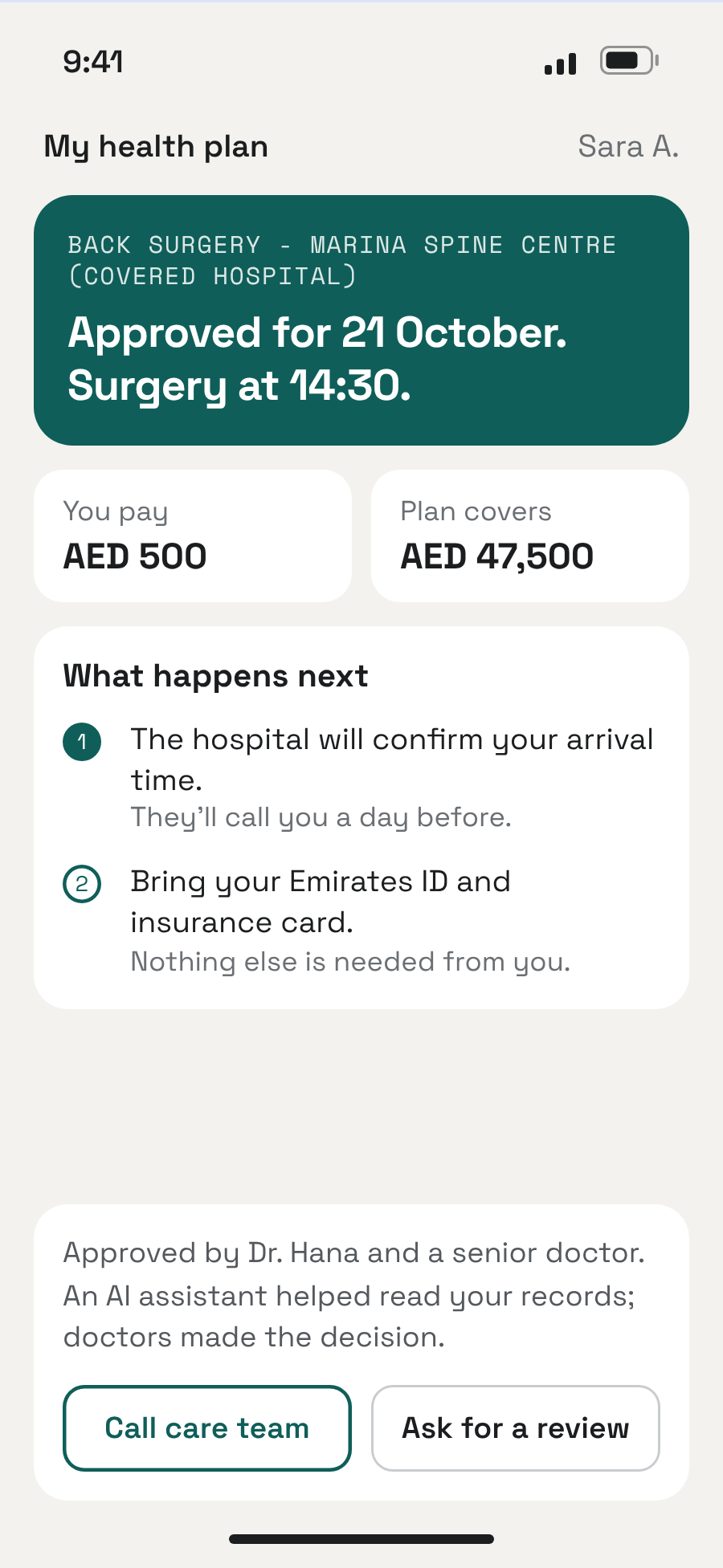
Sara gets three answers: is it covered, what do I pay, what’s next. Waiting never looks like silence.
{{p.kicker}}
{{p.t1}} {{p.t2}}
{{p.d}}
Every suggestion, every signature, on the record.
The regulator, the hospital and the senior doctor need to trust it too. Each case keeps a plain log: what the AI suggested, what a doctor changed, who signed.
| TIME | WHO | WHAT HAPPENED | EVIDENCE |
|---|---|---|---|
| Mon 09:05 | AI agent | Read 14 documents. Suggested: need more documents (MRI report missing). | Request file |
| Mon 10:12 | AI agent | Asked Marina Spine Centre for the MRI report. | Message sent |
| Mon 13:40 | AI agent | MRI report received. 21 checks passed, 3 flagged. Suggested: approve once 1 document arrives. | Checks list |
| Mon 16:58 | Dr. Hana | Decided all 3 flags: counted the earlier physio, new problem so covered, asked the surgeon for the nerve check note. | GP letter, MRI report |
| Mon 17:02 | Dr. Hana | Signed: approve, pending senior review (over AED 40,000). | Signature |
| Tue 07:50 | AI agent | Nerve check note received from the surgeon. | Surgeon’s note |
| Tue 08:30 | Dr. Karim | Reviewed the case and the note. Signed: approve. | Signature |
| Tue 08:31 | System | Sent Sara her answer in plain words. Copy of message stored. | Sara’s message |